
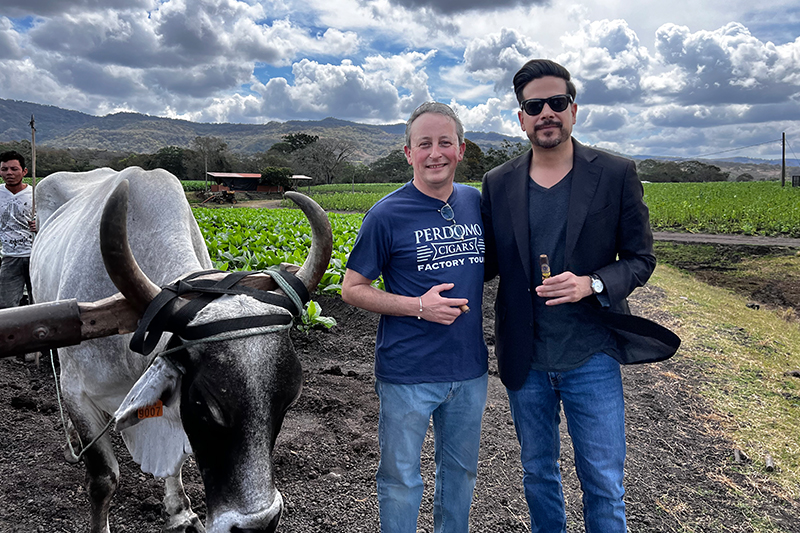
When I walk into a cigar bar in Hamburg, Houston, Nairobi or Nantucket – and I’ve walked into them in exactly those places and many more besides during my allotted number of trips around the sun thus far – I am always distinctly aware of a feeling of stepping back on home soil.
What I mean by that is this; by being a ‘cigar guy or gal,’ you’re instantly part of the family. And though you may be far from home and missing loved ones or feeling under the weather or out of your comfort zone – I can promise you that cigar folk will ease your worried mind.
I know.
Once, I was in Texas, killing time before my next connecting flight. I was a long way into a huge amount of travelling while writing the first book in my travelogue series, Around The World in 80 Cigars – Travels of An Epicure, and instead of sitting in my hotel room and feeling lonesome, I looked up the nearest cigar lounge, ordered a cab and was on my way. Turns out, the place was in an anonymous strip mall, squeezed between a bar and a pool hall and when I walked up to its doors, I wondered if I would be made welcome. It was a very ‘local’ joint, indeed.
I’d stepped no more than three paces inside before a gentleman passed me on his way out and told me: “Enjoy your stick, man.” I felt instantly at home; I should have known better than to doubt the power of the cigar.
In this world of dictats and over-extending government, education is more important to cigars than it has ever been before. We must cherish and protect this world we know is a great one – and educate others about it, too. It is no longer enough to just sit back and hope they leave us alone.
America has a massive role to play in this. Once again, we need the United States to stand up and be counted on to draw a line in the sand. Cigar is not a dirty word.
With its Mom-and-Pop brick and mortars, massive catalogues, online giants and cigar bars the size of department stores, America holds the world’s greatest collection of cigar lovers. While other parts of the world have seen their freedoms curtailed and their ability to enjoy a good cigar legislated to death, there are still many, many places in the US where cigars are welcome, or at least tolerated.
There was another reason I first decided, best part of 10 years ago, to begin creating a prose-heavy, long-form book to be read, rather than looked at. That was because I wanted to introduce, in depth, a new way of highlighting the great that cigars do. I call it cigar literature.
Wine, art, food and more have hundreds of books from well-regarded authors about every aspect of their creation, influence and enjoyment. Why not cigars?
My books do not focus on technical analysis of cigars or delve into the minutiae of brand history. Nor do they contain glossy pictures and stereotyped images of men in fancy suits living the high life. What they do contain – and since that first edition was published in 2019, it has been followed by a second, Around The World in 80 Cigars – There And Back Again – are stories of what cigars were smoked when and where and with whom. That, to me, is as crucial to understanding the gravitational pull that cigars have for so many of us as telling you what leaves were rolled in the blend.
The PCA should be commended for recognising that we have reached a crossroads for the cigar world and that education is a key weapon in our fight to keep that world vibrant, inclusive and viable.
The recent announcement of a special department of International Affairs and Education headed up by my old sparring partner, Ricardo Carioni, demonstrates the PCA’s willingness to be at the forefront of the new challenges we face.
“Creating the next generation of cigar stewards through storytelling, training and advocacy is a key part of our ongoing strategy for the coming years,” says Ricardo.
“The US is not only the largest cigar market in the world, but also a vibrant cultural crossroads where traditions converge and evolve. For our industry to survive mounting regulatory pressures, America can do more. It ought to champion, protect and export the deeper values behind them. Through education and cultural exchange, the US can foster mutual understanding between regulators, producers, retailers and consumers worldwide, building bridges that safeguard the past while paving the way forward.”
Couldn’t have put it better myself.
As a Brit abroad, exploring the world with no small amount of wit and wonder, I pledge to do my bit to keep cigars a relevant and rewarding artform, where social responsibility, fraternity, friendship and family are at the very top of the agenda.
The question is – will you join me?
Nick Hammond is an award-winning author, writer and podcaster from the UK. He has written for Cigar Aficionado, Cigar Journal, Cigar & Spirits, The Daily Telegraph, The Times, Country Life, FT How To Spend It and more and was voted the inaugural Spectator Cigar Writer of the Year in 2013. As well as penning his own books, he wrote Cinco Decadas: The Rise of The Nicaraguan Cigar to mark Joya de Nicaragua’s 50thanniversary, has just completed an autobiography of Nick Perdomo of Perdomo Cigars, and during lockdown, created a podcast, also called Around The World in 80 Cigars, which has attracted an audience in excess of 40,000 listeners in more than 120 countries.