
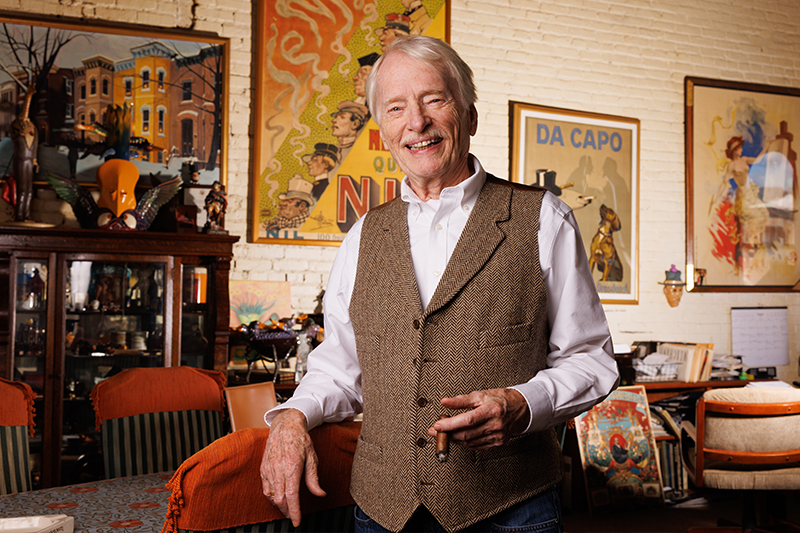
This is not a story about cigars. Nor is it, really, a story about a premium tobacco shop’s diamond anniversary. Those things are on the periphery, for certain, but Georgetown Tobacco celebrating 60 years in business is mostly, if not all, about the man behind the iconic storefront.
“I doubt this will be interesting, but let’s give it a try,” says David Berkebile during our interview. A profound understatement but a quote that gets to the heart of David, as both a businessman and person—humble to a fault and genuine to the core.
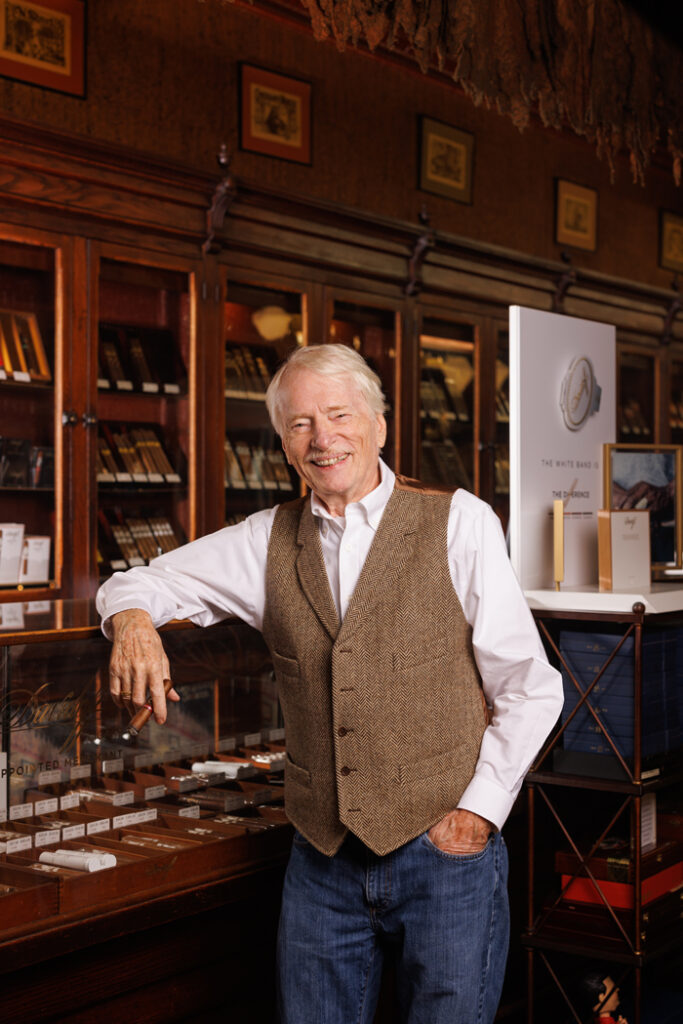
When we in the industry talk about the filler of the cigar, we’re talking about the inner essence, the important flavors and nuances underneath the glossy wrapper that make or break a cigar’s success. The same can be said for a person, and that is where David has defined a six-decade career.
“You know it’s funny,” says Teresa Wessling, who worked for David in the 1990s and then returned to Georgetown Tobacco in 2014. “There are so many stories that I could tell you about his kindness to the staff, to me, to different manufacturers over the years, but I can’t tell you those stories because he wouldn’t think it was right. He’s so selfless and giving, and it’s a big part of how he’s built the reputation that he has in the industry. You could talk to so many different people, whether it’s customers, retailers, manufacturers, and you say, ‘David Berkebile,’ and they all just smile.”
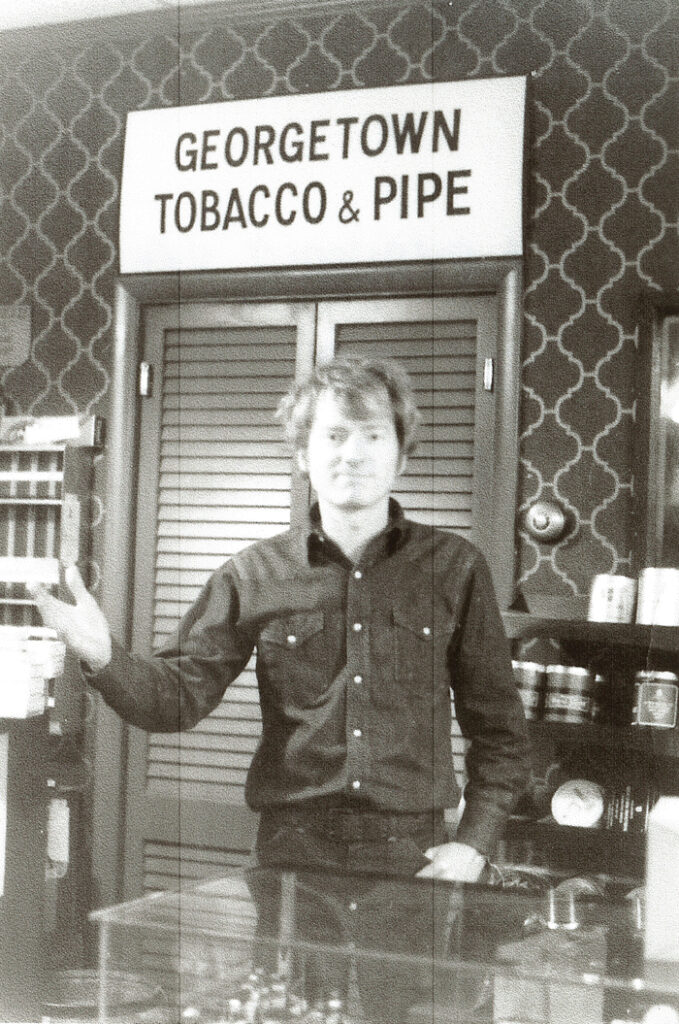
David’s career began in the premium tobacco business on March 15, 1964, when Georgetown Tobacco & Pipe opened in a small space on Wisconsin Avenue in Washington, D.C. At 24 years of age, with only a marginal knowledge of tobacco (he smoked a pipe while in the Navy and shared occasional cigars with friends), to say it was a risk is perhaps too kind, but then you must tap into the mind of an entrepreneur. At age 7, David was selling ducks to the neighborhood kids. Later, he was going to the corner store, buying candy and then reselling to his friends. When his father asked how much he was selling the candy for, David said the same price he bought it for—a teachable moment for the father and a first lesson in profit margins for the son.
In other words, this was someone who was always recognizing a need and finding a way to fill it. He wasn’t naïve to the challenges (“There were many people that said I was crazy”); he just knew that if he put in the time and effort, it was worth a try. And he believed, and still believes, that cigars and pipes have that inimitable power to create memorable moments and to connect people in indelible ways.
Indeed, his business plan was based largely on the power of relationships. “Those first years, I learned a lot from my customers and a few generous distributors who gave me a year to pay on my inventory,” says David. “I’ve never been much of a salesman but I like people and I think they like me. I try to be a trustworthy person. My word is my bond. It’s being straight with people and working hard and caring, those are the keys to success. I enjoy people, and if they end up buying something after our talk, all the better.”
Paul Garmirian, founder of PG Cigars, is a prime example of David’s largesse. A friend since the 1960s, it was David who encouraged Paul to research and write The Gourmet Guide to Cigars in 1990 after Paul’s 15-year career in teaching and real estate. When the book was published, it was David who invited Paul to speak at the PCA (then RTDA) show to promote his book. And leading up to that show, which happened to be in D.C. that year, it was David who replaced his store’s front window display with only Paul’s book so all the retailers coming into D.C. for the show would see it. The first edition of The Gourmet Guide to Cigars sold out in three days.
“Let me just say that David doesn’t like compliments, but he deserves the highest recognition for his contribution to the cigar industry,” says Paul. “Personally, the support I got from him is immeasurable. David is someone who is extremely fair, considerate, firm, and he gives everybody a chance. In other words, if somebody comes up with a new brand, he’ll give it a chance. I don’t want to say [Georgetown Tobacco] is a testing ground for cigars, but whenever there is something that is available, it’s like a laboratory. His store is a laboratory.”
This laboratory has had a reverberating effect on the industry. Teresa remembers her first trade show and the realization of David’s influence on the premium tobacco world. “My first trade show was ’98, in Nashville, and back then we used to go to the trade show with 12 people, and I was thrilled that he asked me to go. People, vendors, they would see Georgetown Tobacco on my badge and physically try to pull me into their booth because they knew that if they could get their product into Georgetown Tobacco, that other retailers would be interested in carrying it. So I turned my badge over.
“Then I look at David, and he is literally going from booth to booth to booth. Instead of just paying attention to the products and the things that they’re selling, he’s talking to them. His approach at the time, and it hasn’t changed, is that if he meets somebody he likes and he thinks he can help them in some way, he will.”
David’s influence over the years has gone beyond friends, cigar makers and customers. He also understood and recognized the impending challenges the industry would face from anti-tobacco groups and onerous regulation. In the late ’90s he joined the RTDA board—becoming president in 2006—and he saw immediately that the organization needed a restructuring in order to effectively advocate for premium tobacco. From its existence, the RTDA was mainly a trade show organization run by an executive director with not much oversight or authority given to the board.
“I wanted it to be a true organization where the board runs the thing, not one man,” says David. “That’s what we changed under my leadership. There was some upheaval, but that’s what had to be done and that’s what I did, with other people’s help, of course. I also didn’t like the name of the organization because it had the words ‘dealer’ and ‘tobacco’ in it. I thought we needed to separate ourselves from tobacco and so I proposed IPCPR and I got it passed. Of course, it was a funny acronym but we needed a name with cigars and pipes in it. It was a pretty intense time, because we were also fighting the State Children’s Health Care Initiative (SCHIP) that came in with a tax increase of 10,000 percent. But there were so many battles in those days.”
There were some dark days, and many in the industry wondered if their businesses would survive it. “David was instrumental as the past president of the IPCPR back when the cigar industry was almost taxed out of business by the Democrat-backed SCHIP cigar tax,” says Jeff Borysiewicz of Corona Cigars, who worked alongside David advocating for the industry. “He allowed us to use his office as a D.C. headquarters while we were lobbying and doing what we could to stop the onerous tax. Back then, the IPCPR was headquartered in Columbus, Georgia, so Dave’s generosity was extremely helpful.”
Never to miss an opportunity of inspiration, to honor the work he and the organization did in building the advocacy arm of the PCA, in 2009, David and Walter Gorski, his vice president, traveled to Rocky Patel’s factory in Danli, Honduras to create Georgetown Tobacco’s house brand Caucus cigars. The blend was designed to complement the flavor of the Ecuadorian Sumatra wrapper leaf, which is David’s favorite. Caucus comes in four sizes (Churchill, Toro, Robusto and Corona) and has a medium body that can be appreciated by all smoking palates. It has been a consistent seller at the shop since its inception.
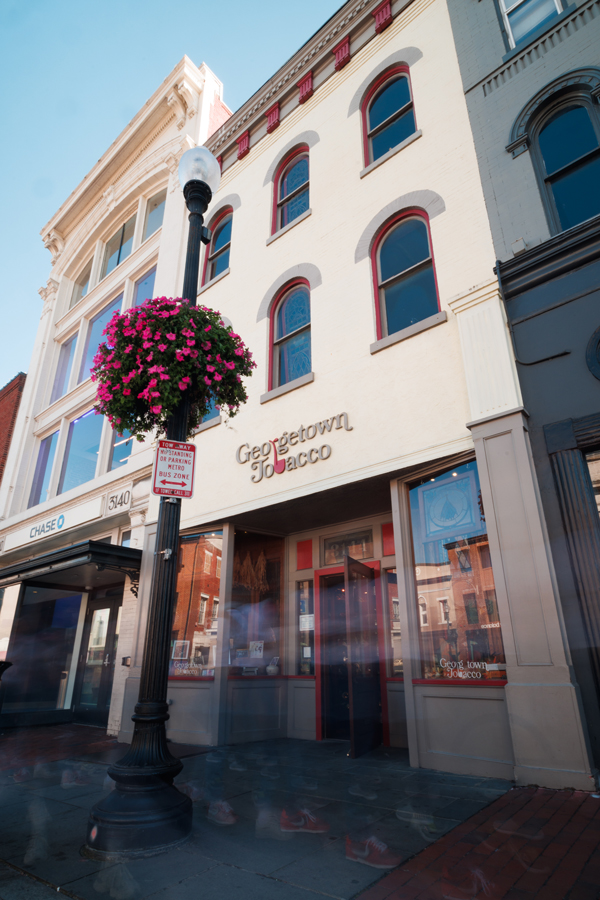
Georgetown Tobacco is indeed a destination for any cigar aficionado, and as one can imagine from its location, the clientele is as eclectic and unique as the Venetian masks (“We are the second largest seller of Venetian masks behind Cirque du Soleil”) and vintage cufflinks that are also for sale at the shop. Through the decades, David expanded to six stores across the Beltway area, now operating just the original flagship store in Georgetown. He was one of the first brick-and-mortars to establish a mail-order catalog business. He was one of the original Davidoff retailers in the U.S. And now he has a growing online platform. He has never stopped innovating, and at 85, he isn’t showing signs of slowing down. He still works at the shop six days a week.
“It’s the greatest place on Earth,” says Teresa. “I mean that sincerely. It’s why I’m here. When you walk in the door, you know that it’s something special. And the people who work here and the people who shop here appreciate it. David empowers us to do what is right and he’s more interested in making sure that people who work for him and his customers are happy and fulfilled. Seriously, I cannot think of another business where you could literally be helping someone buy a $2.50 cigar and in the same hour another customer will spend $10,000 while not batting an eye. And regardless if they spend $2.50 or $10,000, they’re going to have the same experience with us, period.”
Thankfully, David does find a work-life balance. He always has time for a game of backgammon with Teresa, enjoys the outdoors with his wife and high school sweetheart Sandy or just relaxes with a good cigar and good company. But managing his business the right way is never far from his mind.
“I think that the manner in which he deals with people, not only myself, but other brands, customers, anybody, I would say he has the highest ethical standards,” says Paul. “He is fair, friendly and firm, but he doesn’t tolerate nonsense. You treat him right, he will treat you right. You treat him with respect, he will treat you with respect. If anybody wanted to pick a friend, I think you could not find a better friend or a better business associate than my friend David.”
– Story by Greg Girard. Photography by Anthony Bolognese/Capitol Hill Photo – http://capitolhill.photo.
This story first appeared in PCA The Magazine, Volume 4, 2024. To receive a copy of this magazine you must be a current member of PCA. Join or renew today at premiumcigars.org/membership.