The cigars that customers cherish make their way to our humidors by innumerable routes—some as a result of orders placed directly with manufacturers at an event such as the PCA Trade Show, others because of orders placed with product owners or representatives who visit our stores. The world of cigar distribution is in constant flux, and it can be a challenge to observe distinctions among the roles that everyone in the game is playing.
One role that doesn’t get talked about as much as product reps is that of cigar brokers. Being relatively few in number, brokers run a bit more under the radar. But brokers form an essential link in our cigar distribution network—particularly for boutique makers. There is no predicting whether or to what extent any given tobacconist deals with cigar brokers. Tim Davis, who owns and operates the venerable Davis & Son Tobacconists in Wilmington, North Carolina, moves a lot of cigars but says he doesn’t think he currently has a working relationship with any cigar brokers. “I mainly deal with the big manufacturers, who use reps,” says Davis. On the other hand, Jeff Greiner, PCA board member and manager of Classic Cigars of Tulsa in Tulsa, Oklahoma, says he is currently dealing with a number of brokers stocking his humidor.
The difference can most likely be explained in part by the sort of inventory that a given shop specializes in. A store that primarily stocks the larger cigar brands is dealing with companies that can afford to bankroll dedicated product reps. But if you want your shelves stocked with lots of fledgling boutique brands, you will find that those smaller companies usually do not have the deep pockets needed to dispatch a costly network of field employees. Here is where a broker can usefully come into the picture.
Successful brokers: A different kind of operator
While the brand reps familiar to us all are normally receiving regularly scheduled pay checks— and are often reimbursed for travel expenses—small, fledgling brands have to lean more heavily on representation by visiting brand owners or their immediate associates, who must spend long weeks on the road staging retailer events. Still, brand owners and associates from a brand’s HQ cannot be everywhere. Cigar brokers are a natural fit in such cases—independent business people who generally cover their own expenses and manage their own working lives.
Adrian Acosta, who operates The Cigar Culture Brokerage out of Clermont, Florida, says, “The broker model isn’t for everyone. You’re operating without the safety net of a salary. You’re building your own book of business, and you’re managing multiple brand relationships simultaneously. Most reps in this industry work directly for a single manufacturer. Not brokers. We are a genuinely rare breed.”
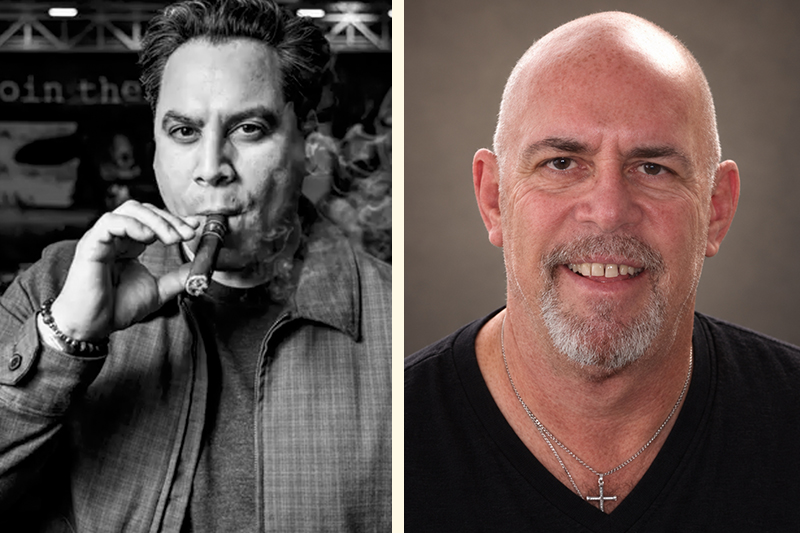
Just how rare brokers truly are is a matter of some speculation. Acosta figures there aren’t more than 12 to 15 full-time brokers working in the field at any given time. He describes the life thus: “A conventional brand rep works for one company. Their loyalty, their pitch, their entire visit is focused on moving that one line. A retailer with a brand rep gets depth on one brand but has to manage 10 different reps to fill out their humidor. A broker is different. I come in representing multiple complementary brands, which means I can have a real conversation about a retailer’s entire assortment: what’s working, what’s missing, where there’s a gap I can fill,” Acosta says. “For the retailer, one visit from me can accomplish what might take three or four rep visits otherwise. So I’m efficient. I’m not trying to jam one SKU down their throat because it’s the only thing I sell. From my perspective, the challenge is that I have to be equally passionate and knowledgeable about every brand I carry. You can’t have a weak link. But the reward is that I get to curate a portfolio, and that makes me a resource rather than just a salesperson.”
Craig Cass, who owns a number of Tinder Box stores in the Carolinas, says he believes that many boutique brands “don’t offer brokers enough volume to pay the rent.” The fundamental problem that brokers face is that “they are always working themselves out of a job, because if the brand succeeds, then they lose the brand. So there tends to be a lot of churn among brokers. In that way, effective brokers at some point can become victims of their own success.”
On the other hand, we hear a more upbeat assessment from Steve Amari, who operates SA Cigar Broker out of eastern North Carolina. Amari says, “I keep getting calls from new cigar brands. As a broker, you want to work with as many brands as you can handle, but only as many as you can handle well.” He says it is important that a broker know when he or she is reaching max capacity, and not to take on too much. “Social media has helped boutiques to proliferate. Boutiques are here to stay. They are still growing. But getting boutiques into stores is a marathon, not a sprint. It’s a rarity when you just walk into a lounge and make a sale. It takes time to develop a relationship. I’m not just seeking out new customers. I’m looking to meet new business partners.”
Amari, who authored an e-book titled Be Unique, Sell Boutique, explains, “When I first enter a humidor I study what’s in there. A lot of stores need someone like me to help spot what is moving and what isn’t. Lounges tend to concentrate on selling what’s safe, so that they can make their money back. But I can show the people staffing a shop how to move a lesser-known product. For instance, boutique brands won’t move if they are concealed way up on a top shelf. Buyers of the big brands can find their cigars no matter what. But customers looking for boutiques might need a little more help finding their stuff.”
The grind of brokering
Brian Schmittdiel, CEO of Founders Holding Co. and Founders Fulfillment, says, “Most boutique cigarmakers are using brokers.” Schmittdiel is now working with a number of brokers to get Founders cigars into retail humidors. “For us, a broker means boots on the ground. Our broker is the first person we pay.” Schmittdiel’s advice: “Treat your broker like royalty. At Founders, we have a Broker Constitution which defines the rules for how Founders works with brokers. Mostly, in this industry, broker arrangements are about relationships and handshakes.” But Schmittdiel also points out, “Brokering is not for everyone. It’s a grind. And you have to have experience with cigars, lounges and shops—with the cigar culture.”
Acosta attests to the grind. “I run approximately 32 round trips a year to the Northeast,” he says. “Six accounts a day, Monday through Friday—30 retailers in a single week. Multiply that across 32 trips and you’re looking at roughly 960 retailer visits per year—nearly 1,000 face-to-face interactions, each one an opportunity to strengthen a relationship, to move product, to grow a brand. If I’m being honest…my address rotates. Monday it’s a humidor in New Jersey, Tuesday a lounge in Connecticut, Wednesday a retailer’s back office in Pennsylvania over a cup of coffee that’s either really good or really terrible—no in-between. Florida is where I sleep. The road is where I live.”
A broker might work on a commission of 15 to 20 percent, and get paid by any number of means: Cash App, direct bank deposit, printed check, etc. Each relationship is unique. One quickly grasps the tenuousness that can easily characterize the working life of a cigar broker. But among those for whom it works, it can work very well indeed.
Amari, now 73 and covering accounts in Michigan, Ohio, Florida and North Carolina, says he had retired in 2015 from a long career in radio broadcasting. “But I had no desire to stop working,” he recalls. Upon receiving his first-ever pay check as a cigar broker in 2021, he realized he’d found something new that he could be passionate about. “I immediately wished I had discovered cigar brokering much earlier.”