
At Florida International University Chaplin School of Hospitality & Tourism Management, we often remind our students that people may forget what you say to them, but they will always remember how you treated them. That principle has never been more important than it is today. That is why the arrival experience at the Chaplin School begins with a warm greeting and a smile, followed by a hug or handshake.
Artificial intelligence (AI) is transforming nearly every industry: answering questions, managing inventory, predicting purchasing patterns, and generating personalized marketing in seconds. These tools are becoming increasingly valuable for premium tobacconists and cigar retailers. But AI has no intention or emotion and it cannot build trust.
Trust is earned through genuine human interaction. It comes from a knowledgeable tobacconist who takes the time to learn a customer’s preferences, understands the occasion they’re shopping for, remembers a previous purchase, or introduces someone to a new cigar with confidence rather than a sales pitch.
That is hospitality.
At FIU, we’ve spent considerable time studying what the age of AI means for hospitality education. We believe that as technology becomes more capable, human skills become more valuable. AI raises the standard for technical efficiency, but it also raises expectations for the very skills that hospitality emphasizes: empathy, critical thinking, adaptability, creativity, and relationship building. The premium cigar industry has always understood this. Customers rarely visit a cigar shop simply to buy cigars. They come seeking advice, discovery, conversation, and community. The finest premium tobacconists create an environment where customers feel welcomed, respected, and comfortable asking questions, whether they are purchasing their first premium cigar or adding another rare release to an already impressive humidor.
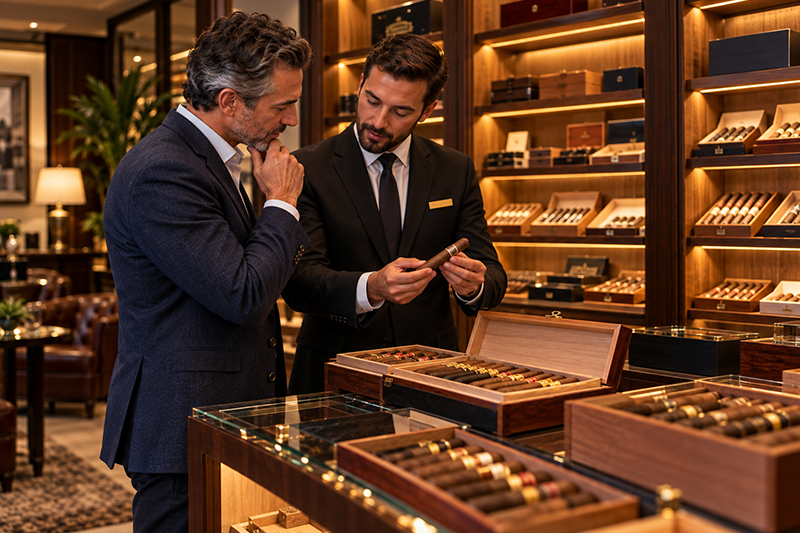
A knowledgeable staff member does more than recommend a cigar. They read the customer, ask thoughtful questions, and recognize whether someone wants education or simply affirmation. They know when to introduce a complementary pairing and when to simply enjoy the conversation. That judgment cannot be automated because it depends on emotional intelligence and authentic human connection. These skills are no longer “soft skills” but rather, competitive advantages.
As AI takes on more mundane and transactional work, your team’s greatest value will come from what technology cannot replicate: the care in every interaction, the adaptability to meet whatever the moment calls for, the thinking that turns a routine question into real judgment, the ability to create experiences worth remembering, and the human connection that makes a customer feel known rather than processed.
This shift also changes how we should think about training. Product knowledge still matters. Knowing wrapper varieties, origins, fermentation, aging, construction, and flavor profiles is expected. The retailers pulling ahead are approaching relationship skills the way hospitality schools have long approached service education: as a discipline to be studied, practiced, and refined, not a trait some employees happen to be born with. In our classrooms, we pair theory with deliberate practice — students shadow seasoned professionals before they lead a service encounter on their own, rehearse reading a guest’s needs through structured roleplay, and learn to document and recall preferences so no relationship starts from zero. The same model translates directly to the retail floor. Managers can pair new hires with their most skilled staff for supervised shadowing before they sell solo. You can also conduct simulations that train employees to read a first-time buyer differently from a seasoned collector. Or, utilize a tip that I learned a long time ago—keep a shared customer notebook so any staff member can pick up a relationship where the last conversation left off. Most importantly, build in a simple follow-up ritual or a call or handwritten note after a meaningful purchase that extends a single transaction into an ongoing relationship.
None of this takes new technology. It just takes a shift in mindset: hospitality is a skill you build, not something people either have or don’t. The retailers who come out ahead won’t necessarily have the best inventory on the shelf. They’ll have the best people behind the counter.
The future does not belong to businesses that compete against AI. It belongs to those that marry AI’s efficiency with humanity’s unique ability to build relationships. Technology should free your staff from routine tasks so they can spend more time doing what matters most: connecting with customers.
For premium tobacconists, every visit is an opportunity to create more than a sale. It’s an opportunity to create exceptional experiences, belonging, and loyalty. In an age where technology can do almost anything, making people feel welcome may become the most valuable skill of all.
– Contributed by Michael Cheng, PhD CHE, Florida International University. Photo Illustration: AI-generated using OpenAI’s ChatGPT.
This story first appeared in the 2026 PCA Annual. To receive a copy of this magazine, you must be a current PCA member. Join or renew today.